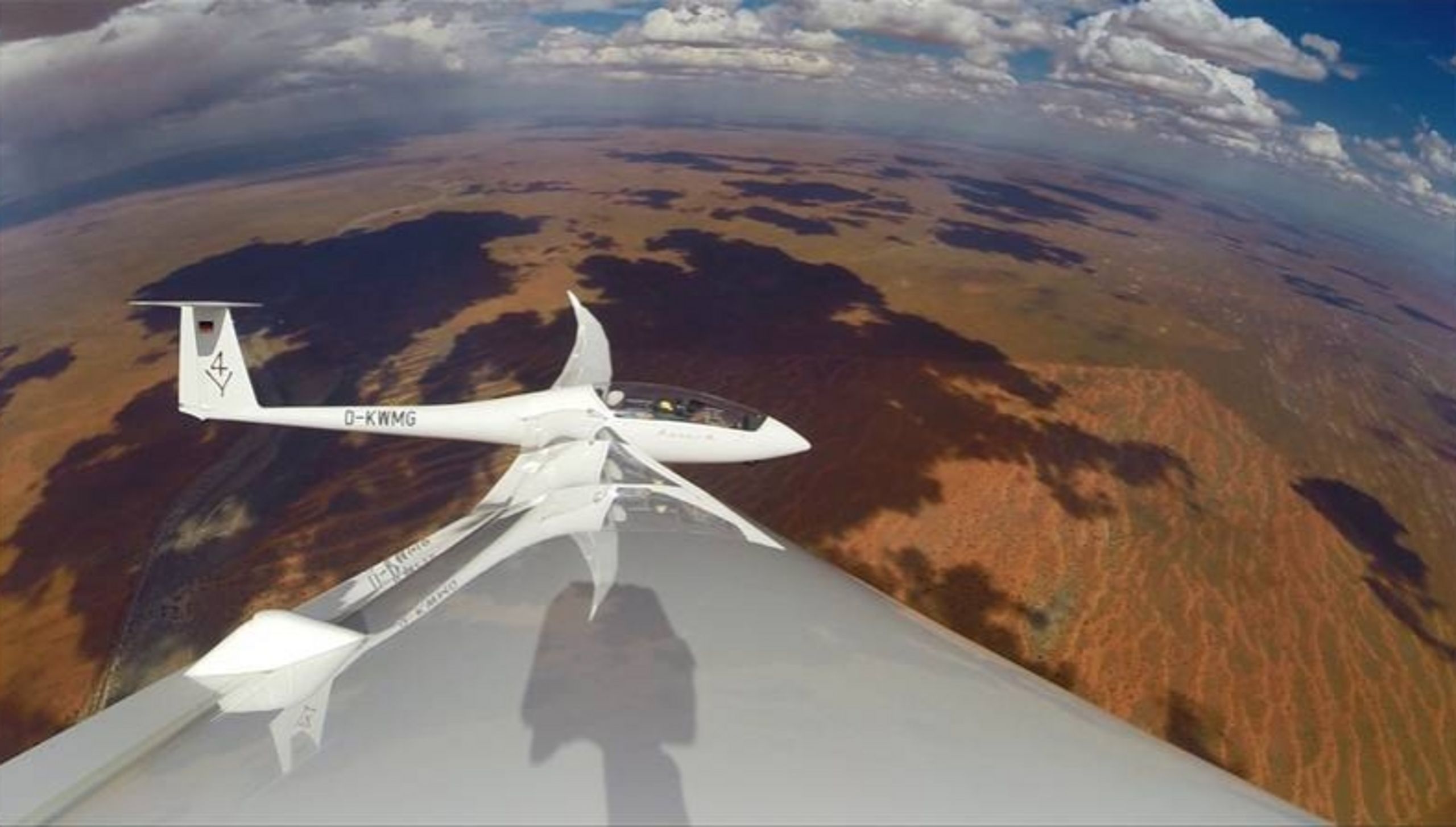
The two experienced pilots has succeeded probably the longest (in kilometers) flight in South Africa. We congratulate on this spectacular flight.
Here the flight report:
The forecast for the 2 January 2016 appears to promise really good day. A completely overcast sky with lots of spread-out cumuli on the evening of 1 January cast some doubts on the weather models. In the morning, however, the sky is clear and after an unusually early take off at 9:40 local the first climb already takes us to 3800 m ASL. The terrain here has an altitude of roughly 1300 m. The first 160 miles take us due south - running under cumulus - to our first turn point in Prieska. We arrive at Prieska at 12 a.m. at an average speed of 75 mph. The second turn point is Vryburg in the North-West. We now plan to attempt a 688-mile FAI triangle and we make the 250 miles to Vryburg in 2h 37 min, which corresponds to an average speed of 97 mph. We realize that it is just 14:37 and we have covered more than half of our planned distance. The next 175 miles to our turning point deep in Botswana bushland are covered at a speed of 155 km/h, and we start the remaining 125 miles of our final leg back to Kuruman at 16:30. Sunset is in 3 hours. After we arrive at our finish point we use the remaining time to overshoot our destination using a convergence line until sunset. The total distance finally amounts to 856 miles within a 688-mile FAI triangle.
Such distances are rare, even in the soaring centers in Namibia, but for South Africa this is probably the largest published flight in miles ever. What is the reason for this new performance dimension in the double-seater class, which is aptly documented in numerous flights on the OLC?
For a long time such flights were the privilege of open-class gliders. These gliders can - due to the low sink rates - utilize thermals when other gliders can no longer or not yet cover reasonable distances. Modern gliders in the double-seater class are now changing this paradigm. At a similar maximum take-off weight (in the case of the Arcus that is 800 kg) and resulting wing loads of more than 50 kg/m2 these gliders have a very good high-speed performance. At the same time, modern wing sections allow for a low sink rate at slower speeds, which is needed for the thermally weaker parts of the day. These characteristics make modern double seaters ideally suitable for high-speed days, for example in Spain or in Africa. In both cases the flight distance is less determined by the end of thermal convection and more by the daylight available. High average speeds until sunset are the norm.
Add to that the easy handling - both in the air and on the ground - and the two-pilot team in the cockpit and you end up with a lot of potential for long distance tasks.
Karin Wiesenthal and Markus Geissen