

The dominance of the Arcus is already a familiar sight at most national and international gliding competitions in the two-seater class. This was also the case in 2026 at Hahnweide and clearly demonstrates the confidence pilots have in this aircraft’s performance.
But the Ventus-3 also once again demonstrated its top performance and all-around qualities at Hahnweide 2026.
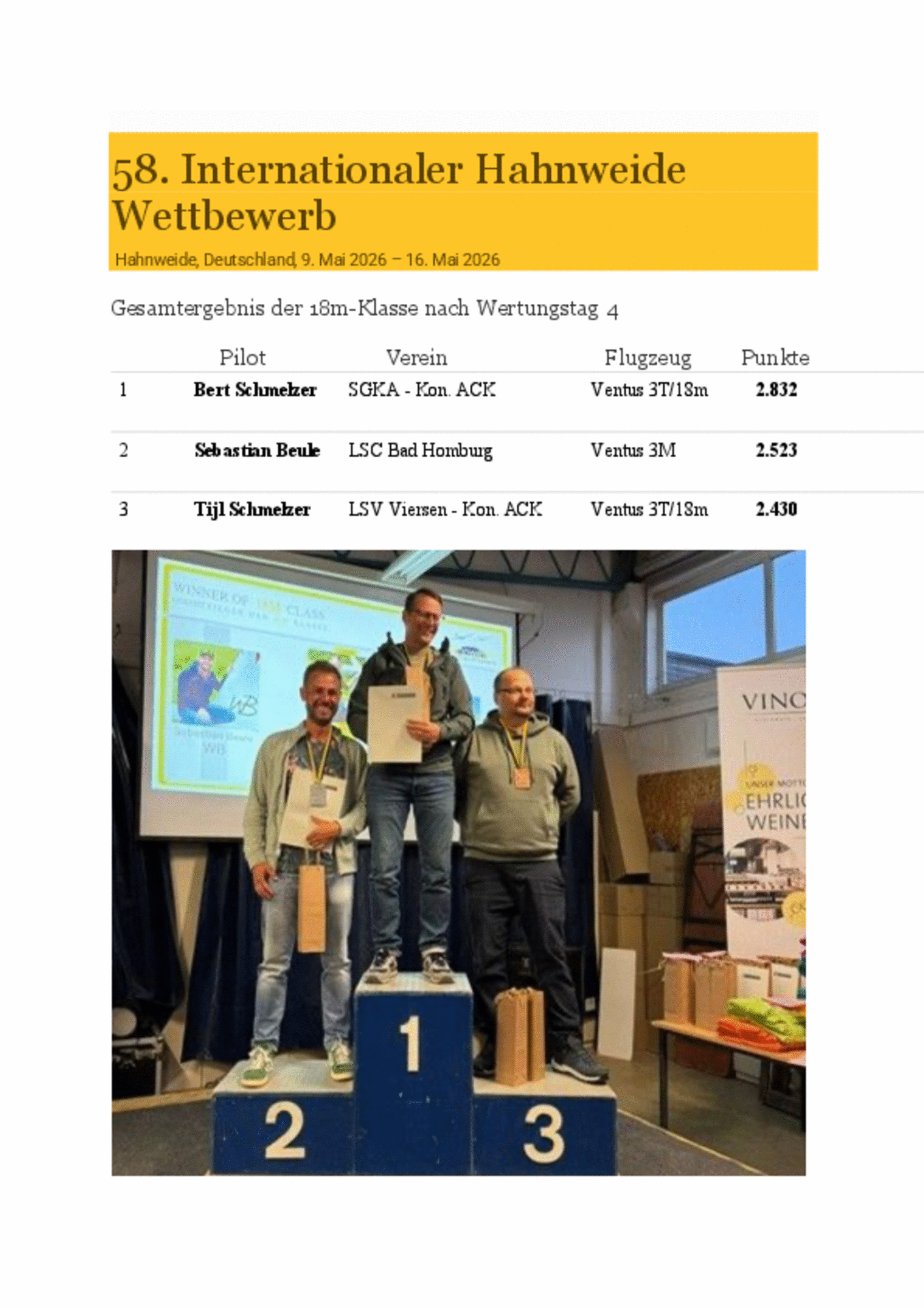
Facing a wide variety of challenging weather conditions, pilots Bert Schmelzer, Sebastian Beule, and Tijl Schmelzer flew the Ventus-3 T and Ventus-3 M to first, second, and third place in this internationally competitive event. The Ventus-3 was also very well represented in the lower rankings. Schempp-Hirth extends its warmest congratulations to all the pilots.
We look forward to the following report from the overall winner of the 18m class, Bert Schmelzer:
Four days, four different worlds
The 2026 Hahnweide Competition was anything but easy. Conditions were extremely challenging on all four days and, at the same time, exceptionally varied. On the first day, there were already rain showers just before the takeoff line, while in the western part of the task only sluggish warm-air thermals could be found. East of the Nördlinger Ries, on the other hand, conditions suddenly improved dramatically with a high base and climb rates of up to 3 m/s. The second day, however, was tactically extremely demanding and brought extensive cirrus clouds, blue thermals, and strong winds ahead of an approaching front. On the third day, rough but powerful cloud thermals, slope flying segments, and a closed 8/8 cloud cover awaited in the northern Black Forest. Finally, on the fourth day, there were again isolated showers, but fantastic lines of thermals and a seemingly endless convergence along the Danube Valley, which only very few discovered. Usually, one or two difficult days decide a competition. This time, the entire competition was marked by four extraordinary and eventful days of competition.
Notably, all four daily victories in the 18m class went to pilots flying a Ventus-3. I was able to win three out of four possible daily victories; my brother Tijl took the fourth. The fact that we won all the daily victories together shows me very clearly just how well this glider suited the prevailing conditions. The key was to stay consistently fast without taking unnecessary risks. And when conditions did get rough, the Ventus—even under high wing loading—helped me get the most out of every situation thanks to its harmonious handling and responsiveness. It climbs exceptionally well even in tight thermals with strong winds and turbulent conditions, while remaining easy and pleasant to fly at all times. That same flying feel also helps in fast convergences and lines of thermals to find the optimal line.
The Ventus simply inspires enormous confidence, especially under Europe’s often complex and changeable weather conditions. For me, its greatest strength is its versatility: on weak blue days just as much as along fast convergences. That was precisely the decisive factor at Hahnweide 2026.
![[Translate to EN:]](/fileadmin/_processed_/6/e/csm_Bert_ba90d6e241.jpg "[Translate to EN:]")